Four questions will disqualify most of the mushroom supplement shelf. Use them on us. Use them on anyone. If a brand will not answer all four in public, that is your answer.
1. Is it the fruiting body, or mycelium grown on grain?
The fruiting body is the mushroom. Mycelium on grain is the fungus grown on rice or oats and then dried with the grain still in it. Published lab analyses of commercial products have found grain-grown products often testing under 10% beta-glucans with 30–60% alpha-glucans, which is mostly starch. Fruiting-body extracts commonly test in the 20–40% range for beta-glucans.
What to look for on a label: the words "mycelial biomass," "myceliated oats," or "mycelium on rice" mean grain is in the bag. "Fruiting body" or "fruiting body extract" means the mushroom is.
One fair caveat: mycelium is not worthless. Some specific compounds are mycelial, and a few branded mycelial ingredients have their own research. The problem is not mycelium itself — it is grain sold at mushroom prices without disclosure.
2. Does it publish a beta-glucan percentage, or only "polysaccharides"?
Starch is a polysaccharide, so a large "polysaccharide" number can be mostly grain. Beta-glucans are the compounds with an actual mechanism behind them, and they are harder to inflate — but only if the brand names the assay and the lab that measured them.
The best labels disclose both beta-glucan and alpha-glucan percentages. A high alpha-glucan figure is the starch tell.
3. Is there a lab report for this lot?
Not a certificate for some batch from two years ago — the lot you are actually buying, with its lot number on it. A useful certificate of analysis names the testing laboratory and shows results for potency, heavy metals, pesticides, and microbials.
Most brands in this category publish nothing. Some publish a generic testing statement. Very few publish the document.
This is not a mushroom-specific problem. In March 2026 Consumer Reports lab-tested twenty-three energy drinks and shots and found eight of them carrying 8–16% more caffeine than the label claimed. What is printed and what is in the can are different questions, and only one of them has a document behind it.
4. Does the claim match the evidence tier?
A brand quoting prescription-drug trials to sell you a morning powder is telling on itself. The most common version of this in mushrooms involves turkey tail: the impressive clinical literature belongs to PSK, an approved cancer adjuvant in Japan, not to retail powder taken by healthy people.
Watch also for test-tube antioxidant results presented as health benefits, and for animal studies described in language that implies human results.
Our own answers
| Question | Fruiting Body |
|---|---|
| Fruiting body or mycelium? | Fruiting-body extracts only |
| Beta-glucan percentage | Published per lot, with the assay method and laboratory named, on our lab results page |
| Lot-specific lab report | Published, and emailed to you for your lot |
| Claims matched to evidence | Every ingredient carries an evidence stamp, including the one the stamp does not flatter |
Row two is the one to hold us to. Our first lot has not been released by the manufacturer yet, so there is no percentage to publish — and we would rather say that plainly than print a number off a spec sheet. The day the certificate lands, it goes up whole. You can read it on our lab results page, and our reading of the evidence is on the research pages.
These statements have not been evaluated by the Food and Drug Administration. This information is educational and is not medical advice.

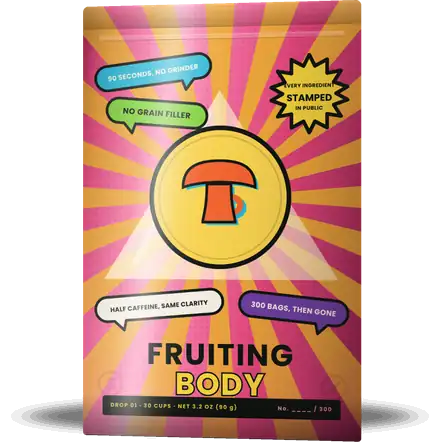
Half the caffeine, same clarity.
- Instant arabica with fruiting body extracts. Never mycelium grown on grain.
- One 3 g scoop, hot water, 90 seconds. No grinder, no brewer.
- A unique blend every drop, released in limited runs.
- Free shipping over $45. Ships in 1 to 3 business days.
Two bags $59. 14 day returns on unopened bags, less a $5.99 flat return shipping fee.
Does mushroom coffee taste like mushrooms?
Why most of it tastes earthy, and the reason is not the mushrooms.
How much caffeine is in mushroom coffee?
The Mayo Clinic numbers, and why half the dose is a trade worth making.
No cap, no stem, six human trials
What it is, where it came from, and what every trial measured.
Five mushrooms, one page each
What each one is, where it came from, and what researchers have measured.